Interface Photonics Lab
介面光電實驗室
Research & Initiatives
•The ani-RSHG analysis on as-grown samples showed difference in Ge distribution in samples with the multi Si/SiGe structure (preliminary GAA structure), which is not well observed in synchrotron x-ray diffraction (XRD) spectra.
•For the annealed samples, the response to changes in Ge concentration and its gradient in depth reveal the Si/Si1−xGex interface intermixing.
•Results of high-angle annular dark-field STEM and energy dispersive x-ray spectroscopy agree well with the Ani-RSHG with SBHM findings.
• Owing to sensitivity on the evolution of dipole structure in the Si/Si1−xGex layer, the analysis method of Ani-RSHG with SBMH has high potential to be real-time monitoring at the nanoscale, which can further realize the actual structure change in GAA caused by small recipe difference and by any post treatment during fabrication.
Nonlinear optical nondestructive analysis of GAA structure

•The ani-RSHG analysis on as-grown samples showed difference in Ge distribution in samples with the multi Si/SiGe structure (preliminary GAA structure), which is not well observed in synchrotron x-ray diffraction (XRD) spectra.
•For the annealed samples, the response to changes in Ge concentration and its gradient in depth reveal the Si/Si1−xGex interface intermixing.
•Results of high-angle annular dark-field STEM and energy dispersive x-ray spectroscopy agree well with the Ani-RSHG with SBHM findings.
• Owing to sensitivity on the evolution of dipole structure in the Si/Si1−xGex layer, the analysis method of Ani-RSHG with SBMH has high potential to be real-time monitoring at the nanoscale, which can further realize the actual structure change in GAA caused by small recipe difference and by any post treatment during fabrication.
High-resolution non-destructive analysis of doping levels in semiconductor ultrathin films
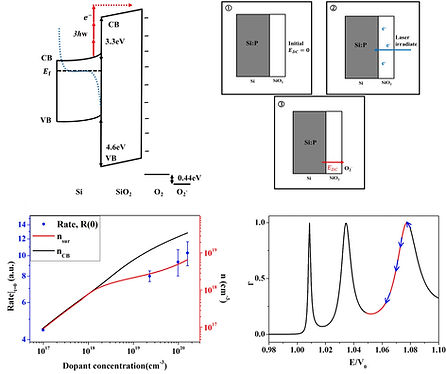
The dopant concentration of doped Si ultrathin film (DSUTF) which is below 10 nm is evaluated non-destructively by second harmonic generation (SHG). The technique is based on analyzing the evolution of the internal photoemission induced charge trapping and the concomitant electric field induced SHG.
We further demonstrate a strategy to estimate the dopant concentration by considering the Fermi-Dirac distribution and the tunneling probability, without involving the crystallinity of DSUTF. The dopant concentration between 10^17 and 10^20 (atom/cm^3) is unambiguously evaluated by this method. The unprecedented approach of using non-destructive method to reveal dopant concentration of DSUTF via time-dependent SHG constitutes an important step towards in-line monitoring and optimizing the fabrication conditions.
Non-destructive optical analysis of semiconductor thin film interface defects
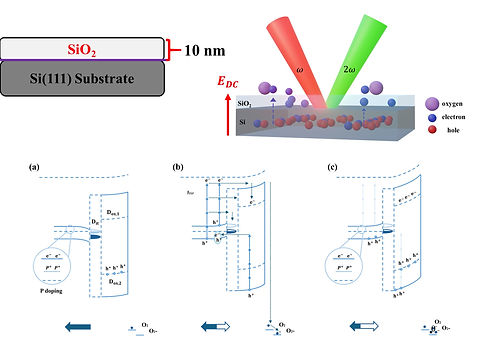
We demonstrate the potential of second harmonic generation (SHG) as a nondestructive and real-time optical method for Dit detection. By analyzing time-dependent SHG signals, we developed a comprehensive model incorporating charge density evolution and quantum tunneling effects. A simplified equation is derived and fitted to experimental data using a physicsinformed neural network (PINN), revealing a strong agreement between theoretical predictions and measured results.
The extracted coefficients exhibit a clear correlation with Dit, verified through a conductance−voltage analysis. To improve computational efficiency, we employ PINN with transfer learning, reducing parameter extraction time from 30 min to less than 10 s while maintaining comparable accuracy. This study highlights SHG combined with PINN as a promising alternative to conventional electrical measurements, offering a fast, noninvasive approach for semiconductor interface characterization, which can significantly enhance the efficiency of future device fabrication and optimization
Research on the Forward Extension of Gas Sensors for Two-Dimensional Materials
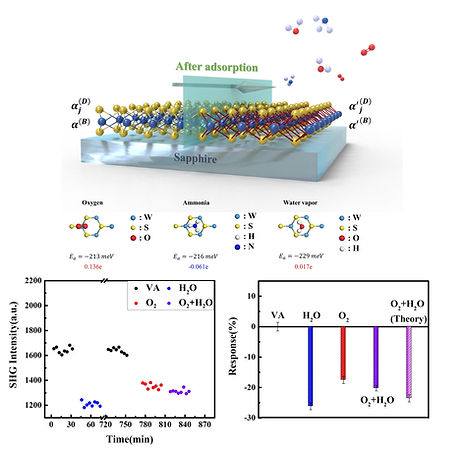
This study explores the potential of layered 2D materials as a candidate material for gas sensing, employing non-destructive measurement, and second harmonic generation (SHG). The investigation focuses on analyzing oxygen, ammonia, and water vapor adsorbed on a WS2 surface by studying the evolutions in electric dipole and electric field. Leveraging the simplified bond hyperpolarizability model (SBHM), a foundation is established for gas sensors utilizing high-quality 2D materials. This approach facilitates the detection of material modifications in response to environmental influences, including the inevitable water molecules. The obtained hyperpolarizability from SBHM exhibits remarkable consistency with Langmuir’s adsorption model, confirming the physical adsorption in the system. In addition, the competitive effects between gases are explored by comparing experimental results with theoretical predictions based on Boltzmann distribution and density functional theory (DFT)calculations. These findings pave the way for advanced studies on gas competition in multi-gas adsorption systems, potentially enhancing our understanding of gas interactions in varied environmental conditions.
Revealing the Active Role of the Gate Electrode in Weak-Light Detection
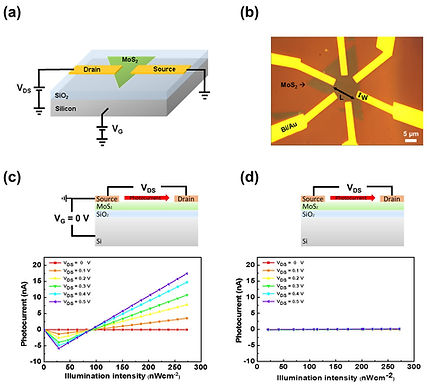
Under weak illumination, photocarriers primarily originate from the silicon gate rather than the MoS2 channel. Absorption spectra confirm that light is mainly absorbed by the gate, driving a negative photocurrent (NPC). The NPC magnitude and slope vary with illumination intensity and VDS, suggesting transport dominated by Si/SiO2 interface traps.
NPC persists when MoS2 is replaced with Au/Ti, reinforcing the gate-driven mechanism. At higher powers, band bending reverses due to competing photovoltaic and trap-induced
potentials. These results highlight the active role of the gate and offer strategies for device optimization.
These findings challenge conventional assumptions regarding photocurrent generation in thin-film FET photodetectors and underscore the critical role of the gate material, offering new insights for the design and optimization of next generation optoelectronic devices.
Physical AI (PINN) for detecting gas sensors and interface defect analysis

This study hypothesizes that the first few layers of the neural network are primarily responsible for capturing the fundamental features of the physical field and the spatial manifold. By freezing the parameters of the first two pre-trained layers, we can fix the fundamental representations and then delve deeper into how the deeper layers of the network perform structural optimization under higher-order physical constraints (such as partial differential equations).
In the PINN architecture, we believe that the shallower layers are responsible for mapping the geometric coordinate features of the physical domain. By freezing the first two layers, we can more accurately observe how physical-informed constraints guide the deeper networks in function approximation and solution space fitting.
(1) In the SHG experiment, Only one set of SHG data and fine-tuning the last hidden layer, we aim to significantly reduce the computation time while mitigating the risk of overfitting.
(2) In gas sensor, only resistance signals, it is possible to infer physically interpretable ratios of adsorption and desorption rate constants and to accurately reconstruct the gas adsorption curves. Such information is typically difficult to obtain using traditional simulations, classical machine learning, or black-box deep neural networks.